

ReliVision Platform Overview
What the platform is, the components you actually work in, the modules and engines behind them, and the ways the architecture scales.
What it is
The ReliVision platform
ReliVision is an end-to-end platform for building, training, deploying, and maintaining AI-powered visual inspection applications. Designed to work across industries and imaging technologies, it enables users to create custom inspection solutions by combining ready-to-use AI models, image processing algorithms, measurements, and decision rules into a single workflow.
At the core of ReliVision is the inspection pipeline — a configurable sequence of AI and processing blocks that transforms visual data into actionable inspection results. Users can design pipelines, train and compare models, validate performance, and deploy complete inspection applications into production environments.
ReliVision provides a unified environment for data scientists, quality engineers, automation specialists, and operators to collaborate throughout the inspection lifecycle. With support for on-premise deployment, integration with existing manufacturing systems, and ongoing model improvement, the platform gives organizations full control over their AI-powered inspection solutions.
What you Interact With
Front-end components
End users interact with ReliVision through the following front-end components.
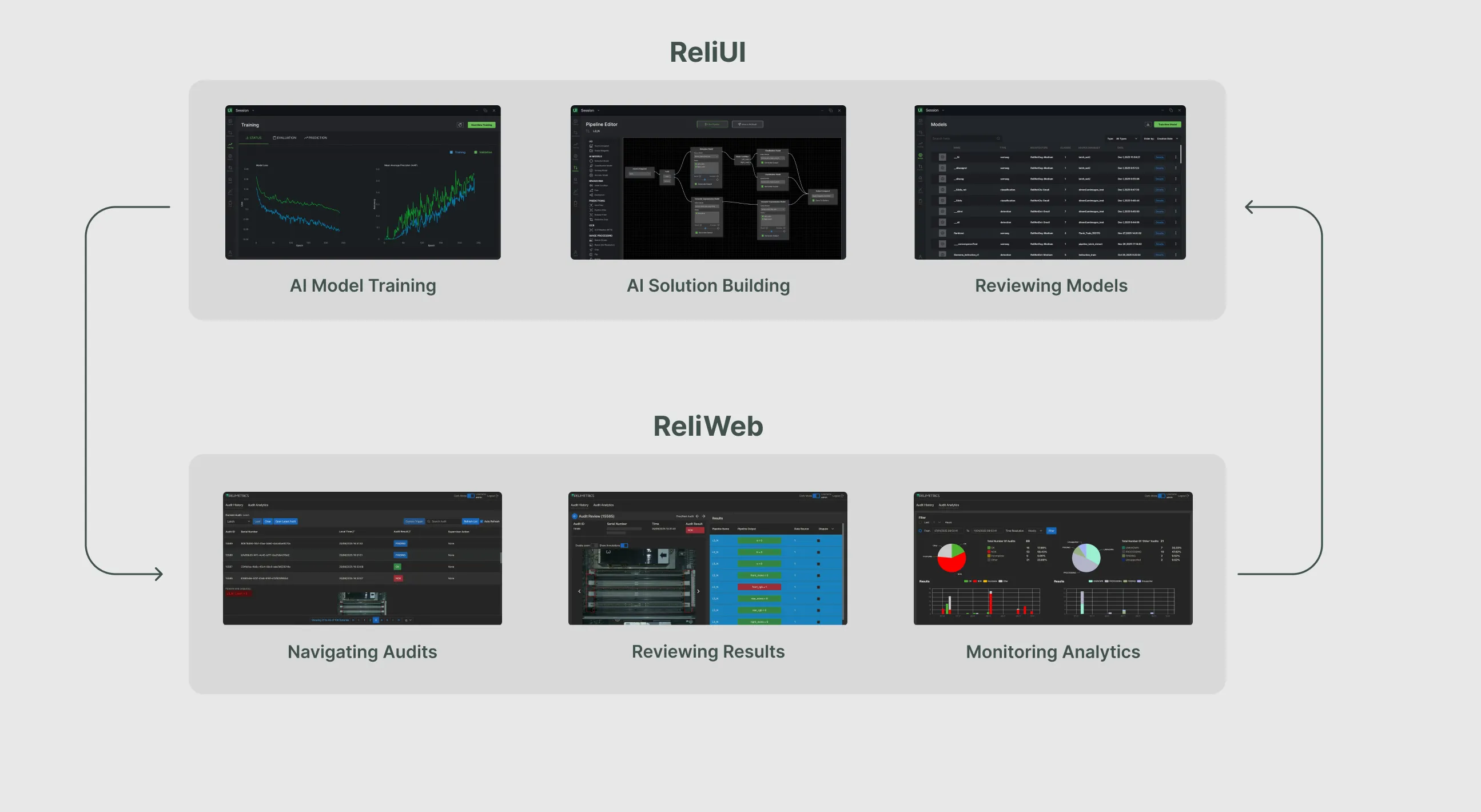
ReliUI
The unified desktop application for managing the entire AI inspection lifecycle. ReliUI enables users to annotate data, configure and train AI models through ReliTrainer, build custom inspection pipelines, and deploy solutions through ReliAudit. It also integrates asset management, model evaluation, user management, and system log monitoring into a single interface.
ReliWeb
The web-based interface for monitoring and reviewing inspection results from ReliAudit. Users can view individual inspection results, analyze performance statistics, and provide accept or dispute feedback directly through their browser.
What sits behind it
Modules and architecture
ReliVision is built on a modular, flexible and scalable proprietary architecture. Its main building blocks are the Relimetrics Training Engines (RMTEs) and the Relimetrics Inference Engines (RMIEs). The whole architecture is based on a distributed micro-services concept, so all components can be deployed locally on-premises, remotely on cloud, or both — and scaled up easily.
ReliTrainer
The training component of ReliVision, powered by the Relimetrics Training Engine (RMTE). ReliTrainer manages data preparation, AI model training and retraining, testing, validation, and deployment preparation. All functions are accessible through ReliUI.
Powered by RMTE
ReliAudit
The production runtime component of ReliVision, powered by the Relimetrics Inference Engine (RMIE). ReliAudit handles data acquisition, integration with automation systems, execution of inspection pipelines, and generation of real-time inspection results. Through ReliWeb, users can review results, analyze statistics, and provide feedback to support continuous model improvement.
Powered by RMIE

How it grows
Scalable by design
ReliVision's modular architecture enables organizations to scale AI inspection operations across production lines, facilities, and use cases without redesigning their solutions. The platform supports three levels of scalability:
Multi-Site Deployment
Deploy ReliTrainer and ReliAudit across multiple machines, production lines, and facilities, with local, cloud, or hybrid configurations.
Multi Use Cases
Run multiple training and inspection tasks concurrently, with built-in queue management to optimize resource utilization.
Flexible Hardware Resources
Scale computing capacity by adding CPU and GPU resources. ReliAudit also supports multiple data sources, including cameras and industrial imaging systems, within a single inspection setup.
User account management allows custom profiles with variable access rights. Communication between ReliUI and the engines goes over secure VPN connections when all servers are private to the customer, on-premises or on cloud; where an external server is involved, HTTPS is used. Shop-floor operations are time-sensitive, so RMIEs are best deployed on on-premises servers connected directly to the data sources over 10 Gb/s LAN.
Next in the guide
ReliUI
Annotation, training, pipeline editing and deployment — the application where the work happens.
ReliWeb
Reviewing audit results, statistics and accept or dispute feedback in the browser.
Installation guide
Requirements, prerequisites, the Client and Server installers, updates and licensing.



