

ReliVision Platform Overview
What the platform is, the components you actually work in, the modules and engines behind them, and the ways the architecture scales.
What it is
The ReliVision platform
The ReliVision platform is an end-to-end custom solution development environment for designing, training, deploying and perfecting AI-powered automated inspection pipelines on any visual data. The industry- and data-source-agnostic platform brings pre-implemented AI models to end users. The pipeline concept — an end-to-end inspection solution — is at the heart of ReliVision. In its most general form, a pipeline is composed of AI Blocks (AI models) and Basic Blocks, such as digital signal and image processing functions.
You can design custom automated inspection pipelines; train, test and compare alternative pipelines; and deploy, monitor and improve them. ReliVision provides a collaborative, secure and managed environment for multiple users with different profiles — data scientists and engineers, operators, automation engineers. It is this unified, streamlined collaborative environment that lets teams get the most out of AI for automated inspection, in industrial and academic settings alike.
What you work in
Front-end components
End users interact with ReliVision through the following front-end components.
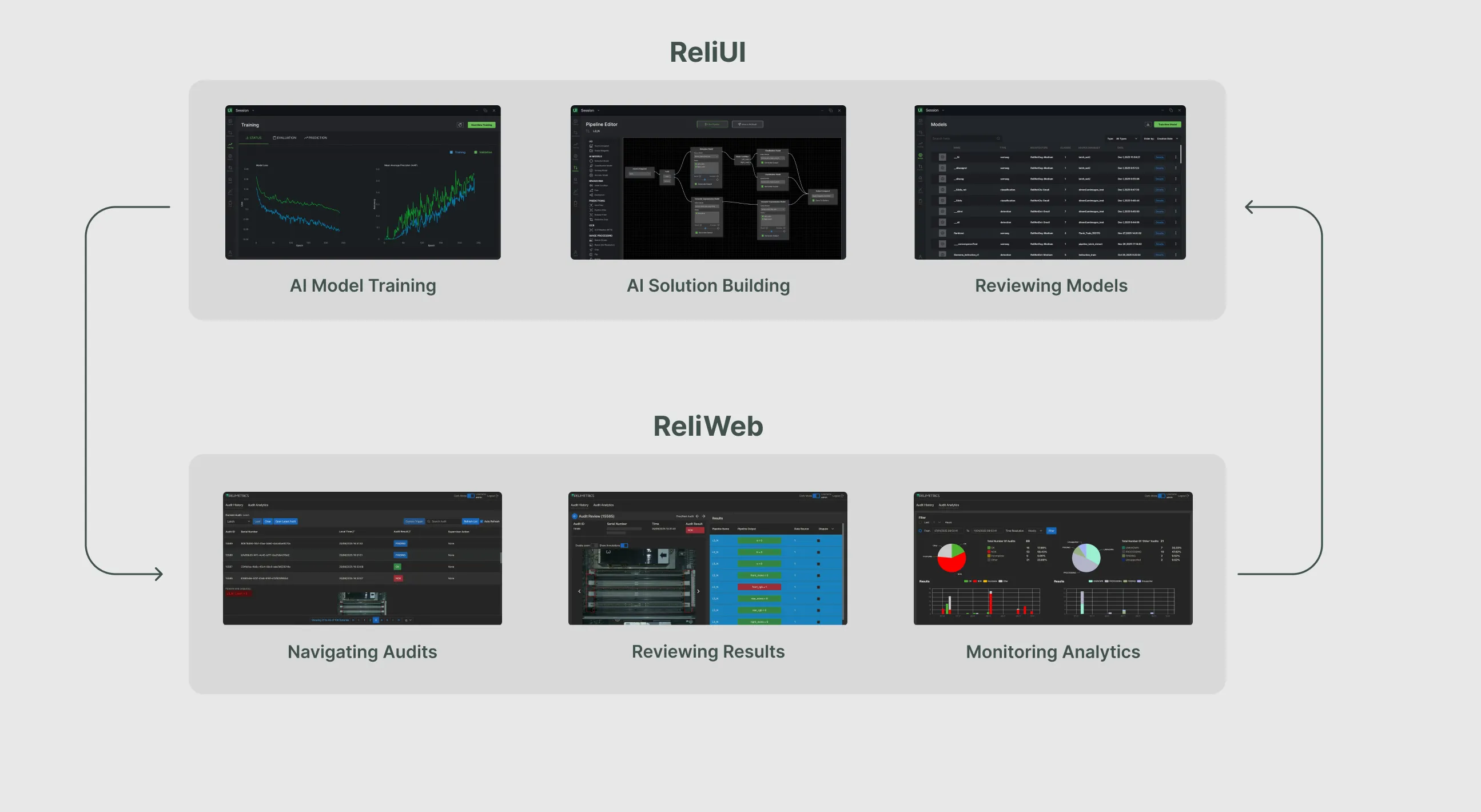
ReliUI
The unified application for the entire AI inspection lifecycle: data annotation, training workflows for ReliTrainer, pipeline editing for inspection logic, deployment interfaces for ReliAudit, and the former ReliBoard capabilities — web-based asset management, AI model evaluation, user management and system log monitoring.
ReliWeb
The web-based interface for ReliAudit. Users review individual audit results, analyse audit statistics, and give accept or dispute feedback directly in the browser.
What sits behind it
Modules and architecture
ReliVision is built on a modular, flexible and scalable proprietary architecture. Its main building blocks are the Relimetrics Training Engines (RMTEs) and the Relimetrics Inference Engines (RMIEs). The whole architecture is based on a distributed micro-services concept, so all components can be deployed locally on-premises, remotely on cloud, or both — and scaled up easily.
ReliUI
The unified front-end through which users reach all ReliTrainer capabilities — data curation, AI-powered solution design, model (re)training, testing, pipeline configuration and deployment. It also carries the former ReliBoard features: user management, process monitoring, asset oversight, and dataset and model dashboards.
ReliTrainer
Built on RMTEs. The engine responsible for data curation, AI-powered solution design, model (re)training, testing and deployment orchestration — with all of its functions exposed through ReliUI.
Built on RMTEs
ReliAudit
Built on RMIEs. The shop-floor and field-deployed component where multi-modal data is collected, automation systems are controlled, AI solutions are executed and real-time inspection results are generated. It includes a web-based HMI on the local database for reviewing results, examining statistics and giving accept or dispute feedback for continuous model improvement.
Built on RMIEs

How it grows
Scalable by design
The architecture is scalable-by-design in three dimensions. That scalability is what makes multiplying shop-floor inspection operations straightforward and cost-efficient.
Multi-site
RMTEs and RMIEs can be multiplied as required, both locally and remotely.
Multi-use-case
Both engine types handle multiple training and inference tasks at once, through an internal queueing system.
Hardware
Engines connect to additional GPUs and CPUs, and RMIEs can take input from multiple data sources such as cameras.
User account management allows custom profiles with variable access rights. Communication between ReliUI and the engines goes over secure VPN connections when all servers are private to the customer, on-premises or on cloud; where an external server is involved, HTTPS is used. Shop-floor operations are time-sensitive, so RMIEs are best deployed on on-premises servers connected directly to the data sources over 10 Gb/s LAN.
Next in the guide
ReliUI
Annotation, training, pipeline editing and deployment — the application where the work happens.
ReliWeb
Reviewing audit results, statistics and accept or dispute feedback in the browser.
Installation guide
Requirements, prerequisites, the Client and Server installers, updates and licensing.



