June 2, 2026
AI Inspection Infrastructure: From AI Projects to Factory-Wide Scale
'This market study was conducted together with ABI Research''
Manufacturers today are no stranger to AI-powered visual inspection. Pilot projects have proven the technology works: defect detection rates climb, inspection times shrink, and quality teams gain visibility they never had before. But a pattern is emerging across industries — and it reveals the real challenge ahead.
The pilot trap
Most AI inspection deployments start as isolated projects. A single camera on one production line, trained on one product, solving one quality problem. The results are impressive. But when the time comes to expand — to the next line, the next product, the next factory — teams hit a wall.
The model doesn't transfer. The setup can't be replicated without the original integrator. The data stays locked in a silo. And every new deployment feels like starting from scratch.
This is what we call the pilot trap: individual AI projects that deliver value locally but can't compound into something larger. The missing piece isn't better models — it's infrastructure.
What AI inspection infrastructure looks like
Infrastructure means moving from bespoke, one-off deployments to standardized, reusable systems. In practice, this requires three capabilities:
Reusable inspection pipelines. Instead of building each inspection from scratch, teams define configurable pipelines — sequences of preprocessing, model inference, and post-processing steps — that can be adapted to new products and lines with minimal effort. The pipeline becomes the unit of work, not the model.
On-prem GenAI for data independence. One of the biggest bottlenecks in scaling inspection AI is the dependency on real defect data. New product lines don't have defect histories. Rare defects don't generate enough samples. On-premise generative AI changes this equation by synthesizing realistic training data from just a handful of examples — without sending anything to the cloud.
Software-defined inspection logic. When inspection logic lives in software rather than hardware-specific configurations, it becomes portable. Build once, deploy anywhere. The same inspection workflow runs on different cameras, different edge devices, different factories — because the intelligence is in the software layer, not the integration layer.
Why ownership matters
There is a fourth dimension that often gets overlooked: who controls the system.
When AI models, training data, and decision logic are owned by the manufacturer — not a third-party vendor, not a cloud provider — the organization builds cumulative knowledge. Every defect concept learned, every pipeline refined, every model retrained becomes a reusable asset. This is the difference between renting intelligence and building it.
Full ownership also means full autonomy. Production changes don't require a support ticket. New products don't require a vendor engagement. Internal teams can adapt, improve, and scale on their own timeline.
From projects to infrastructure with ReliVision
This is exactly the problem ReliVision was designed to solve. The platform provides the building blocks for manufacturers to construct their own AI inspection infrastructure:
Inspection pipelines that are reusable across lines, products, and sites — with configurable pre- and post-processing steps that adapt to new use cases without retraining from scratch.
On-prem GenAI that generates synthetic defect data directly on the factory floor, reducing dependency on real defect samples and accelerating deployment on new product introductions.
Software-defined workflows where models, logic, and data stay under the manufacturer's control — deployable on any hardware, scalable across any number of sites.
No coding expertise required. No cloud dependency. No vendor lock-in.
Join our upcoming webinar
We are hosting a live session to walk through how this works in practice.
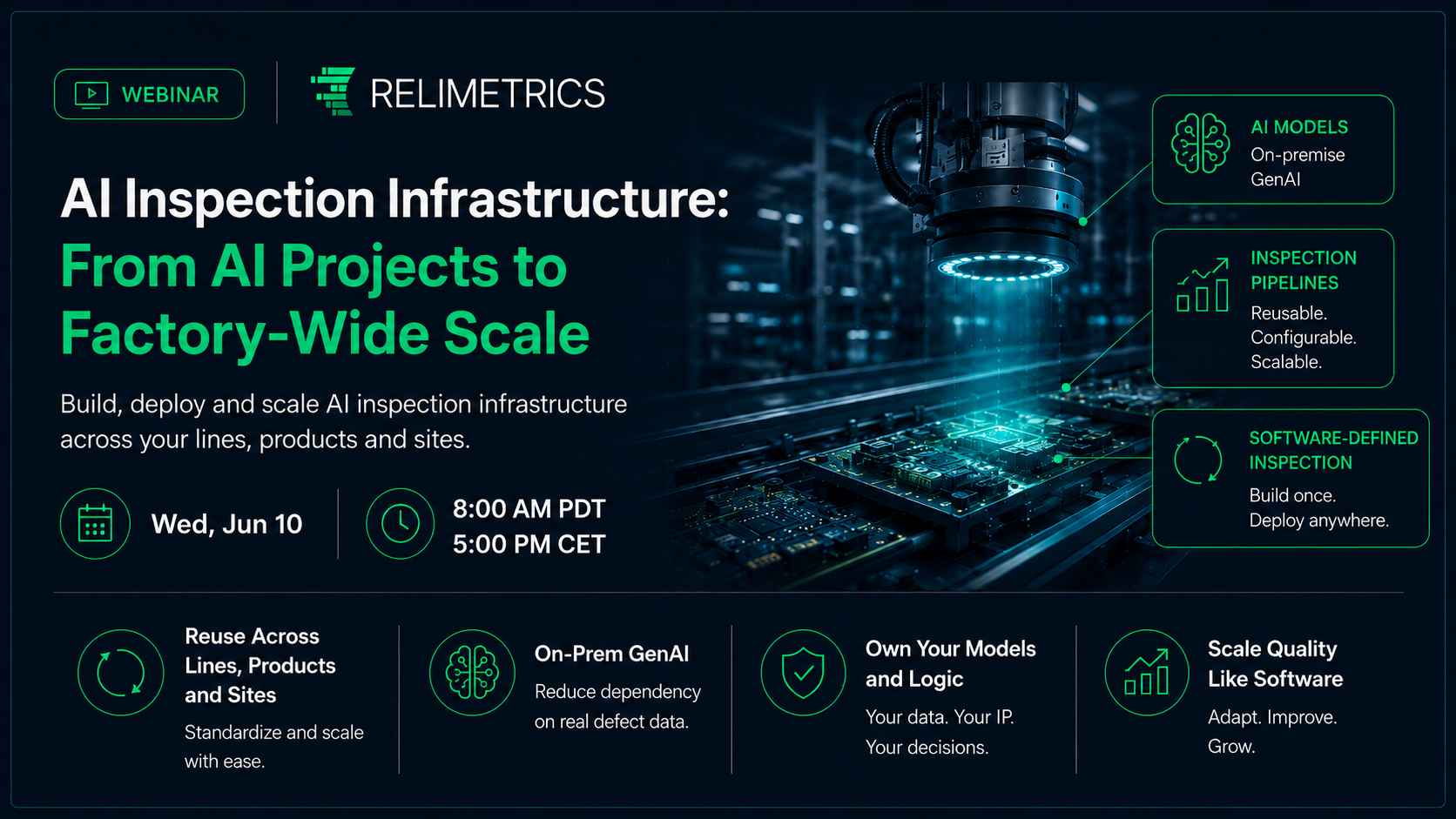
AI Inspection Infrastructure: From AI Projects to Factory-Wide Scale
📅 Wednesday, June 10, 2026
🕗 8:00 AM PDT / 5:00 PM CET
We will cover how to move from isolated inspection projects to scalable infrastructure, how on-prem GenAI reduces your dependency on real defect data, and how software-defined inspection enables build-once, deploy-anywhere workflows.
Build once. Adapt in-house. Scale factory-wide.