May 26, 2026
Accelerating New Product Introduction with ReliVision

'This market study was conducted together with ABI Research''
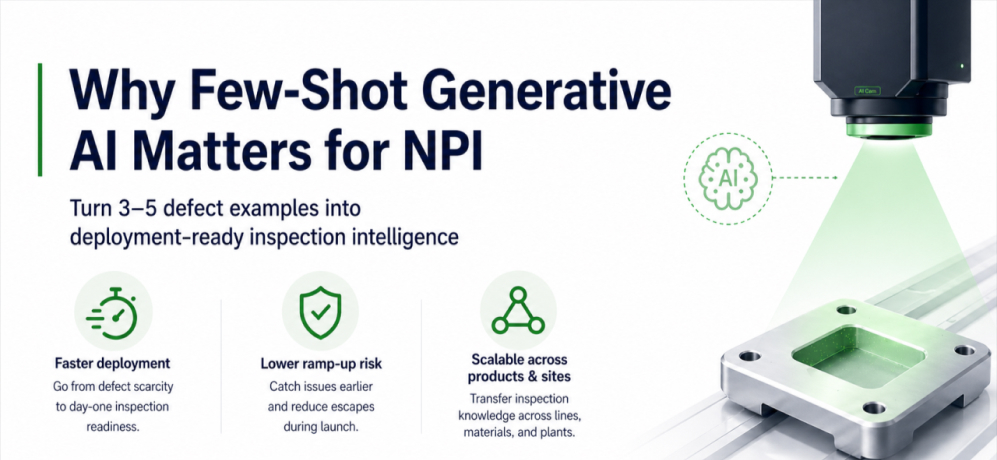
When a new manufacturing line goes live, quality teams face a familiar problem: the inspection system is expected to catch defects immediately, but the training data needed to make that possible usually does not exist yet. That gap between launch readiness and data availability is one of the most expensive blind spots in New Product Introduction (NPI). With ReliVision, we address that gap by using generative AI to create realistic synthetic defects from only a handful of real examples, helping customers bring visual inspection online earlier in the product lifecycle.
The business value is straightforward. Instead of waiting weeks or months for enough real-world defects to accumulate on a new product line, we can work from just 3-5 annotated defect samples to learn the visual structure of a defect and synthesize new examples directly onto clean product surfaces. In effect, we help turn defect scarcity from a launch blocker into a manageable deployment problem.
Why this matters for manufacturers
In most factories, defect data is rare for a good reason: severe defects are infrequent, especially on well-run lines. That is positive for operations, but it creates a real challenge for supervised model training. Standard augmentation techniques such as flips, crops and brightness shifts help only marginally because they do not create the structural variation that matters in industrial inspection, especially for subtle defects like scratches, punctures or hairline cracks.
This is exactly where ReliVision can create value. Our approach is not about generating images for demonstration purposes. It is about solving an operational bottleneck that affects launch speed, quality risk and automation readiness. By combining generative AI with industrial visual inspection workflows, we can help manufacturers establish useful detection performance from day one of a new product rollout.
How we do it with ReliVision
Our approach uses a three-stage generative pipeline. First, we learn a compact representation of the defect using masked textual inversion, which helps isolate the defect from its original background. Because this learned representation is compact, it can be saved, cataloged and reused across future products, surfaces and production lines. Second, we use a conditioned diffusion process to place that learned defect onto new, defect-free target surfaces. Third, we apply post-processing to align color, lighting and local gradients so the result blends naturally into the target material.
That final step is critical. In industrial inspection, synthetic data only creates value if it is realistic enough to teach the detector what a defect should look like on a real production surface. With ReliVision, the goal is not to copy a defect from one image to another. The goal is to learn the defect's structure once, preserve that knowledge as a reusable asset and then reproduce it in a way that is believable on new materials, new product variants and new production contexts.
The performance numbers customers should pay attention to
We see the strongest value in two real-world deployment scenarios: few-shot augmentation and zero-shot deployment.
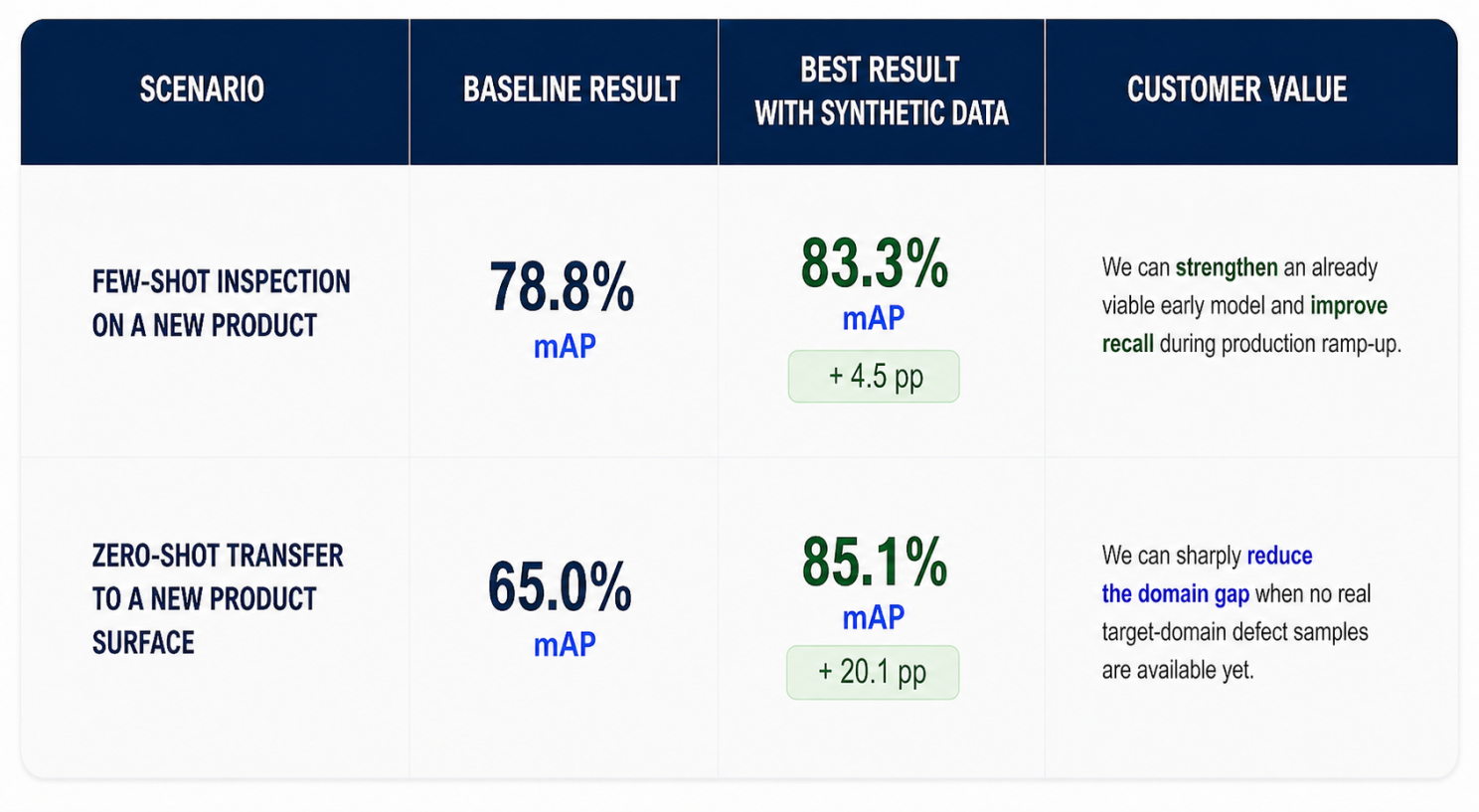
In the few-shot setting, combining real + synthetic data increased mAP from 78.8% to 83.3% and improved recall at the operating threshold from 50.4% to 64.3%. Operationally, that means fewer defects slipping through during the early life of a product launch.
In the zero-shot setting, the implications are even larger. A model trained only on defects from an older product line achieved 65.0% mAP@0.01 on the new product surface. After adapting with synthetic target-domain images, performance rose to 85.1% mAP@0.01. Just as importantly, this means previously learned defect knowledge does not need to be rebuilt from scratch each time. With ReliVision, customers can save learned defect representations and reuse them across new materials, finishes and product families, making zero-shot deployment a cumulative capability rather than a one-off exercise.
What this means for the business
The technical gains matter, but the executive takeaway is even clearer: synthetic defect generation can compress the time between product launch and inspection readiness when deployed as part of a production-grade inspection platform like ReliVision.

This moves inspection from a reactive model, where teams wait for bad samples to happen, to a proactive model, where teams prepare for likely defects before those defects become abundant in production. For companies operating in high-mix manufacturing, electronics, automotive components, aerospace, or precision materials, that can reduce both ramp-up risk and the hidden cost of delayed automation.
Another important advantage is accessibility. The underlying workflow has been shown to run with approximately 16 hours of concept learning on a consumer-grade NVIDIA RTX 5080, under 6 GB of peak memory and roughly 15 seconds per high-fidelity synthetic defect at inference. In practice, that means customers do not need to think of this as a distant R&D concept. With ReliVision, it becomes a practical path toward localized deployment inside factory environments.
There is also a compounding advantage here: every time a new defect concept is learned, that knowledge can be retained and reused. Instead of treating each new launch as an isolated learning task, manufacturers can gradually build a reusable defect library inside ReliVision and apply that knowledge to future NPI programs.
Where this can reshape inspection strategy
The broader strategic value is not just better synthetic images. It is the possibility of letting manufacturers build their own defect library: a reusable collection of compact defect concepts that can be saved, organized and rapidly deployed across products, materials and factories. That makes it possible to scale knowledge, not just models.
Over time, we believe this can support a more modular quality architecture in which manufacturers maintain a portfolio of saved defect embeddings, surface templates and inspection workflows that can be assembled quickly for each new product introduction. In that model, synthetic data is not just a stopgap. It becomes part of the operating system for industrial AI deployment, with ReliVision serving as the platform that helps customers accumulate, manage and operationalize reusable inspection knowledge.
Source note
Performance figures and technical details in this post are based on the attached source document: Serkan Hamdi Gügül and Kemal Levi, Accelerating New Product Introduction for Visual Quality Inspection via Few-Shot Diffusion-Based Defect Synthesis, April 2026. (https://arxiv.org/abs/2604.22850)